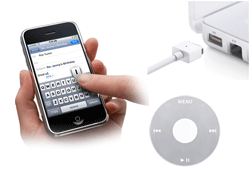
Interface Features
I know you may be getting tired of me always using Apple as an example, but please bear with me for this post. I’ve recently been thinking about how Apple markets their products, and this somewhat ties in to my yesterday’s post on the Nokia N97.
I think what Apple is doing is actually very clever. They’re creating and marketing something that I’ll call ‘interface features’. These are the various interface elements that help you interact with the product, be it a keyboard, trackpad, touchscreen, mouse or a scroll wheel. With their regular product updates they not only change the looks of their products, they also refresh one or two interface elements and market them as new features. Let me illustrate.
Just look at the promotional page for the MacBook Pro. The four features listed on the landing page below the product pictures are:
- Unibody enclosure
- Glass LED display
- NVIDIA graphics
- Buttonless glass trackpad
Out of the four, three of them focus on the interface. The new unibody enclosure design. The glass LED display. The new glass trackpad without any buttons. Only one of the features focuses on actual product performance — the new NVIDIA graphics chip. Other interface features include things like the backlit keyboard, the iSight camera, the magnetic latch, the battery life indicator on the side and the MagSafe power adapter.
Interface features differentiate
I think those interface features are the key in selling a consumer technology product. Sure, your computer or mobile phone may have more storage space and a faster processor, but those things are invisible. The user cannot see or touch them — they’re just numbers. Yes, they may feel an increase in performance, but this is nothing like using and experiencing interface features like a buttonless glass trackpad that they’ve not seen on a competitor’s product.
Look at the other stuff they’ve introduced: the iPhone touch screen and accelerometer, the iPod click wheel, the round scroll wheel on their mouse. These may be big things like the touch screen, or really small things like the mouse wheel, but they are all unique to Apple’s product — or at least were unique when they launched them.
Interface features are the things that you can see, touch and feel — and experience. These are the things that deliver user experience because they are the bridge that gives you access to the functions of that product. To make that bridge easier and faster to cross you need to work on reducing interface friction and make the interface more enjoyable to use.
Interface features sell
Apple does this by constantly thinking of new ways to interact with their products and making their interface features just a little bit different than that of the competition. This gives them the edge. People can see and experience the difference. Apple aren’t marketing performance and hardware. All of those things are a given. They’re marketing new ways of interacting with their products — new interface features that will make your use of their products more productive and fun.
If you’re in a business of selling consumer products, you should focus on and market those interface features. These are the things that will really set your product apart from the rest. Don’t just update the hardware and the looks of your gadget. Innovate. Come up with a couple of unique interface features that will make your product easier and more fun to use. They don’t have to be big, but they need to be unique. Things that the competition doesn’t have.
These are the things that will sell your product — not more memory and a faster chip.
I think Apple has been able to win people over because they’re promoting their products less “machine” like. Through product and UI design, their stuff feels more organic and friendly. This is a stark difference between Apple and non-Apple products.
I remember years ago, clothing companies used to put a lot of “technical jargons” in their advertising. Such as the % of different types of materials used. but nowadays they focus on comfort. Same with auto industry as well.
Users only care about what they see and touch as you mentioned.
It seems very formulaic however what Apple is doing. Every revision they introduce these little things. Some parts of the interface are changed to something the competition doesn’t have — like introducing a glass display in a notebook and a buttonless glass trackpad.
Previous revision they introduced the multi-touch trackpad. Before that it was the inbuilt iSight and the MagSafe connector. Before that it was the magnetic latch on their iBook… and so on and so forth.
They always introduce new interface features. They may be big or small, but they are always unique and they’re always the things that Apple focuses their marketing on. I think it’s a solid strategy that has worked great for them so far.
I seem to say this a lot lately about different things, but here goes:
I can only hope that hardware developers read this article and really understand it. There will always be multiple widgets to do X, but 1 of them will have the best interface. Apple not only makes good interfaces, but they’ve made sure everyone in the world -knows- they make good interfaces. If you buy a new Apple product, you don’t have to wonder if it’ll have a good interface. It will.
I’ve been trying to find a good phone, and the iPhone is not an option since I won’t change providers. How many other phones provide an interface anywhere near as good as Apple’s? Not too many, I can tell you.
I keep hoping everyone will catch on and follow Apple’s lead, but… We’ll see.
Something occurred to me a while back, which I’m sure you can relate as well since we both use Apple as good UI examples a lot :)
Designers, web or ID alike look up to Apple. Who does Apple look up to? Where does Apple get inspirations from?
Since they’re the lead, I think their advantage is not to draw inspirations from anyone else. That may be why they come up with original stuff.
I believe “Think like Apple” have created a bunch cheap Apple knock offs, whether is the web2.0 trend, or cheap imitation hardwares. “Think Different” is the way we should go.
Research and development is expensive. Apple do a ton of it and are always filing patents. A lot of those patents they don’t even use in their products — they just come up with ideas and patent them because they may come in useful in the future.
Not many manufacturers want to risk spending money on research for new interface ideas — I think it’s difficult for them to see how it can translate into profit.
Apple on the other hand not only invests a lot in it, they’re also not afraid to deprecate their own technologies, as seen in the latest MacBook which doesn’t have a firewire port or the Air, which doesn’t have an optical drive, or the new display port on their laptops which doesn’t work with current displays. They’re not afraid because they know their strategy works, and their products sell very well because of it.
Jin: Also, great point about promoting products in a less “machine” like way. They don’t call their phone the N97 — they call it the iPhone. They don’t call their notebooks the HP Pavillion DV5Z, or Lenovo U330, or Sony CS110 — they’re just MacBooks. They don’t call their operating system Microsoft Vista Home Premium — it’s just Leopard.
Call your products by simple names and build brands. Numbers and version names are too cold and not memorable.
I love the way Apple promoted the iPhone keyboard. Everyone knows a touchscreen based keyboard is a big con. But what apple said was: “It’s not bad! You just have to learn how to it ;)”.
What happened is that every reviewer just repeated what Apple said, because it’s true… You WILL learn how to use the keyboard.
What they meant is: “It’s bad, but you’ll get used to it”.
Because in a way, a criterion of ‘a bad feature’ is that you’ll have to get used to it.
Apple markets an “experience”. They seem to be one of only a few tech companies that understand that the current economy is an “Experience Economy”.
Provide a solid user experience and people will overlook your flaws, because your product makes them feel good.
[...] Usability Post » Interface Features [...]
I think Michel makes a valid point, to an extent. There certainly are people who will buy Apple because of their innovation. And then there are others who will do so in spite of it. Not everything Apple does is the be-all and end-all of interface design, and people are willing to overlook those flaws.
Of course you have to do more, and do it well, in order for those flaws to become features and not shortcomings.
[...] 原文:interface-features [...]
[...] Tag darauf dann wird das Thema Interface Features eingehender besprochen. Was Wunder, geht’s dabei natürlich auch wieder um Apple und das [...]