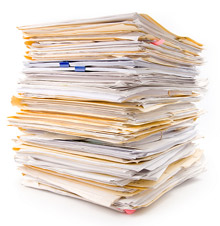
Why We Still Use Paper
With the advent of personal computers we were promised paperless offices. No need to print anything out or jot things down — we have monitors for displaying information and many gadgets and devices for recording things in or out of our home/office. The internet also allows us to store data in the cloud. Digital information is harder to lose, misplace or damage. It can be accessed wherever you are. Yet we still write notes on paper and print out articles to read.
The question is… why?
The problem lies not in the digital media itself — how it’s processed or stored, or any other of its qualities. The problem lies in how we consume it and interact with it. The problem is the interface. Paper is just much more usable than a computer monitor. You can grab a piece of paper in about two seconds and start writing whatever you want. You can draw any diagrams, shapes, charts, pictures — there is little restriction. Paper is also easy to hold and look at — it’s mobile, light and doesn’t tire your eyes like that bright LCD.
On contrast, computer monitors are heavy, fixed and glare a bright light in your eyes that can easily tire. Input methods are limited. Typing on the keyboard is easy, but if you want to draw pictures — well… you could grab a graphics tablet, but that’s not as simple as just sketching things on paper. Sure, there are tablet laptops out there with touch screens you can draw on, but they’re not very accurate either and are definitely bulkier than paper. To save your notes you need to work with the file system. A piece of paper you can just fold and put in your pocket or file in a drawer (although the organization/retrieval is usually simpler on a computer).
Output.
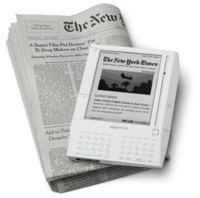
Amazon has started the real transition from paper to digital a year ago when they released their Kindle reader. Yes, other eBook readers have existed previously, but they never really got much attention. Amazon offered not only a reader, but a library of books and an easy way to get them. I believe the Kindle is the first real step towards making a device that will simplify the consumption of digital information and make it as usable, if not more, than paper.
The challenge Amazon faces is to detach the old ‘eBook’ association, and sell the device as a real digital book. eBook readers were clunky old devices that didn’t compare well in the usability department to books. What the world needs aren’t ‘eBook’ readers — but ‘book’ readers. Thin, light devices that instantly turn on and display all your books or documents on a high resolution screen. The real feat to accomplish here is to replace paper as the preferred medium for consumption of information.
Input.
That’s consumption however — input is another story. I think touch screens are essential in devices like these. Flicking pages shouldn’t be done using buttons — you should literally be able to swipe your fingers over the screen and have the pages turn. Of course, now that the information sits in a digital format, you don’t actually need pages anyway.
Sketching things is still difficult with current technologies. It’s much easier to do a quick sketch on a piece of paper or draw a diagram on a whiteboard than to try to do the the same on your computer. There no way to just pick up a pen and draw on the screen. Well… in some cases there is, but I’ve not seen touch screen technology yet that’s as accurate or simple as a pen on paper.
The future.
I think now is the time for a really good touch screen tablet. Something you can use to read all of your books, view all your documents and browse all your photos. Something light and thin that’s not attached to your desk that you can take anywhere with you like a small book. Something with a usable interface that lets you touch the screen to navigate your information. And finally, something which lets you easily input data and draw accurately on the screen.
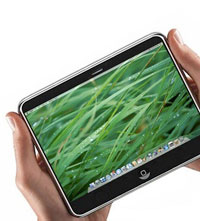
We’re not that far off actually. Products like the Kindle and the iPhone are getting us very close to that reality. A large, thin iPhone-like tablet, with a display that’s easy on your eyes (similar to Kindle) would in my opinion be a device that would replace the need for paper, and I’m really looking forward to seeing this one day; hopefully soon.
If you look back in history, ancient civilizations used to carve letters on stone and clay. This seems very antiquated today. But look at where we really are. We’re burning letters on thin sheets of processed wood. Books really are just thick chunks of wood. Whole libraries are needed to house them. That doesn’t seem like much of an advancement to me.
The real change will happen when the library turns into a server room, and access to all of its books will be available on a light and usable touch tablet. That day will be the beginning of the end for paper.
What do you think? I’d love to read your thoughts on readers like Kindle and what you think their future holds for us. Do you think we need paper?
Paper is also a lot less heavy than any electronic version of the same, when talking about a few pieces of paper… Or even small books.
I have had several PDAs and a Tablet PC, but they are all either too small or too heavy to read anything other than just words on a page. If I want to read a PDF with charts/etc, it needs to be paper-sized and light.
My biggest problems with drawing on the tablet are weight and available applications. The few applications that let me draw well are meant for art, not notes. The few that are meant for notes don’t draw well. (New lines completely obliterate old ones they are over, instead of merging like pen and paper does.)
Basically, it’s catch-22: The technology isn’t there because nobody uses it, and nobody uses it because the technology isn’t there.
With the new foldable screens lately, I expect to see more products that will fit my needs.
As for the Kindle… It’s hideous. I’ve got 10 yr old PDAs that are prettier… And were cheaper, too. And a lot more customizable.
The iPhone has a fabulous free application called Stanza which allows you to read out of copyright books (or pay for recent ones) with an integrated library to download from.
I’ve finally got round to reading all those classics that I promised in my new years resolutions from 2008.
Stanza on iPhone Homepage: http://www.lexcycle.com/
WC: I agree that the Kindle is hideous. Amazon don’t really have any experience building such devices, but I think they at least have the right vision.
We might have to wait until the displays are FLEXIBLE to really replace paper:
http://www.youtube.com/watch?v=Rn10mRyBqAE
But yes we’re getting closer every day!
Thanks,
Brian
You point out the two big issues - consumption and content interaction.
I think you are seeing a huge transition on the consumption side. Devices (Kindle, iPhone, Blackberry, etc) are pushing forward with delivering content we would like to consume. We read and mentally catalog this information - or the content drives us to another content. So a glorified library book, check it out and read it.
But yes, the content interaction part is extremely lacking. (By content interaction I am referring to personalizing the content - drawing, highlighting, notating.) The issue I see is any of these actions are usually separate from the reading application. There is no all in one reading, consumption, notation, bundling application.
There is a good reason why the Kindle is not carrying textbooks right now. Without this type of experience, interacting with a textbook would be frustrating and adoption would stall.
The answers are not in touch screens or flexible paper. Until we move away from consuming content like a word processor, the “e-reader” is just that, a reader.
Most of what you say is inevitable about the notion of moving away from print, but there’s still a emotional experience that you have when you pick up and hold a great printed piece, there just is, and it can’t be duplicated by a computer…yet. There’s still a disconnect with using a computer as a reading / paperless device.
If we look back in history, in order for a new technology to phase out the old, there has to be a strong practical reason for it.
Typewriter to computer, digital becoming more popular.
As for paper, in many areas it’s already been phased out. Email replaced snail mail, paycheck stubs are now sent electronically, newspaper losing to online format etc.
Since this post is more focused on book, my take is:
regardless of the advancement of technology, printed books will be here for a good while. Not forever, but for a good while. I think there’s a lot more to this than practical reasons. It’s more of a psychological thing. An electronic gadget can hold a library, but it can’t replace the feeling of holding a paper book.
I think the enjoyment of a book is more than just absorbing its content, but rather a feeling that comes with it. Same goes for photography too. Digital is cheap and instant. But regardless, there will always be people who use film cameras.
just MHO of course.
I don’t see paper being replaced any time soon. I think people like to hold, and possess things. Why haven’t CD’s been fully replaced with their digital counterparts? Because we like to collect, to own. A Digital version of something seems more like a copy… something anyone can possess. Holding a good book, and turning the pages is an irreplaceable experience.
To me, anything digital is more fragile than paper (weird I know). But Images and documents on a computer aren’t images or documents they are data, and data can be easily changed and manipulated.
Working in a library I have used microfilm and it seems out dated at times. However, it is more permanent than any data you have. Sure it can be burned or copied but you cannot change the information on it. If you had a copy of the N.Y. Times on file, a skilled hacker can change what appears very swiftly, bringing doubt to the validity of a source that references it.
Ink isn’t easily manipulated on a page the way code is. A digital photo isn’t nearly as permanent as a Polaroid or film-based image is. I agree that having data easily accessible and traded is a good thing for all of us. But that information is always vulnerable because it is, as you said, in the cloud.
I think paper will always be around.
I think you just need to boil it down to the basics. Paper is easily accessible, you can take it into almost any environment, and it never has to be “powered” or “charged.” It can “survive” in the coldest of weather, or the hottest of weather. There are no electronic functions that could ever malfunction or stop working.
As much as I’m happy with the ‘privilege’ to Zoom-in (digital), I think no digital publication can replace the feeling and experience that accompanies traditional printed publications!
I agree with a lot of the comments here. I don’t see digital books taking over paper books for a long time.
As Alan Valek and Jin said above, psychology and the emotional experience are the biggest factors in this I think. I buy cds because I want to feel like I own the product - buying digital files doesn’t feel like I really own it. It’s the same with books.
I’ve been tempted to get an eBook device, but I see it being a high risk purchase. They are not cheap devices, and there’s a high chance that I won’t use it enough.
Plus, there are few things more fun than going into a book shop browsing at a vast collection of books, and sometimes buying a completely random book on the spur of the moment. Now you can’t do that digitally!
Related to eBooks, Simon Wardley posted (http://blog.gardeviance.org/2008/10/looking-for-good-author.html) about a different type of digital book. It’s a paper book, but with digital ink which, if you click it, will interact with your computer. It looks really exciting, and the sort of direction I would really want books to go in.
I think the next tablet or book reader will need to have a very very nice fit and finish because as many comments have said, books feel nice to hold.
I don’t think the experience of holding a nice object is exclusive to books though — it’s just that a lot of electronic devices are made of cheap plastic and so end up feeling cheap and soulless. If you use expensive materials and put the device together with a nice design, I believe you can achieve the experience of holding something real, something valuable.
When there is an eBook reader I can hold in one hand while I’m standing on the subway, and turn pages with that one hand, that’s the one I’ll buy. It should be the size of a paperback novel, and offer the same resolution and contrast.
Anything less than that won’t see mass adoption.
I agree Vance — this needs to be a high quality product, not just a cheap plastic reader. I think we already have the technology to create this though. Before the iPhone came out, nobody thought a phone could deliver such a rich user experience — Apple’s product changed all that. I don’t think Apple knew what the results would be either, they just had the vision for a better product.
Computers are great for working with information. These are situations where you want to both write and read. But sometimes you just want to read for example. Most people don’t read books on their computer because it’s just too uncomfortable. Similarly, nobody does quick sketches on their computer because that input mechanism isn’t in place. Once both of these issues are tackled, we’ll see the real transition from paper to digital, and I believe a small touch tablet device could be that solution.
When we reach the stage that e-anything can be rolled up, tucked under the arm and taken to the toilet, used to swat a fly or a spider, feels tactile like paper, etc… we can say we’re getting there. Our relationship to paper has a lot more to it than the ability to read. Paper can be earmarked, sketched on with anything that makes a mark, it makes us feel good because it’s from the environment (for good or bad), it can be used to wrap fish and chips.
IMO several things in the near future will work against paper. We’ll decide en masse that paper for newsprint is an absurd waste of natural resources and the resulting ink leached into the environment is bad. However, we’ll agree that books have more lasting value than newsrag so books will remain in print. Making paper also uses water, I’d imagine, which is becoming a large issue. Maybe we’ll keep certain newspapers, but mostly that stuff will move to the e-environment.
We’ll see different business models sell us e-books etc… but real books are a part of our historic culture. They’re here to stay.
So, until we create something that looks like paper, acts like paper and can be abused with the resilience of paper - e-anything isn’t quite there. As humans we enjoy paper and it’s connectivity to our historic identity. And, seriously, we need to do a lot of AI work to come up with better input / interaction models than mouse, keyboard, tiny touchpad before we’ll be using e-anything like paper, as Dmitry mentioned above.
So test number one - can we roll it up and swat that fly while reading on the toilet?
Personally, I love sitting back with a novel and enjoy the texture of the paper / cover in my hand. It’s a warm joy to run my fingers along the type and use one of the bookmarks I collect to keep track of where I am. As a semi-book collector / hoarder I have further pleasure in revisiting them in the hallway over the years, looking at their covers, their uniquely bound spines.
E-books, in particular, have a tough battle matching that world view.
Paper has become even more useful in a digital age. As digital data storage continues to change, data must be transferred to the new medium or be lost as the tools to read it with become obsolete or hard to obtain. (Read floppy disk, ZiP disk, reel-to-reel…) Whereas paper, although fragile in many respects, is still readable after even centuries of care. (As long as the language written is still understood.) And stone and clay last even longer! There are ‘archives’ many thousands of years old that can still be viewed.
Really, it all comes down to how data can be read. With digital media there has to be an extra layer of technology in order to retrieve the data and make it human readable. This extra layer requires resources that paper simple does not need.
Having a map on paper while lost in the woods is much better than a map in on a laptop with a dead battery!
Great article!
[...] Why We Still Use Paper « Usability Post. [...]
[...] over at UsabilityPost muses about our attraction to paper as well. See his post “Why We Still Use Paper.” Many of his conclusions are accurate, I believe. We’ve been looking into this at work [...]
All good points, but what we are forgetting also is the cost.
Such a device would be expensive, whereas a 500 sheet ream of paper cost less than £5.
Yes in the long run it will be cheaper, but its that initial cost that is a hindrance. Not only must devices have all the features you have outlined, it also has to be cheap and abundant enough that it would be affordable to have up to 5 of these devices. Many times I have been studying and I have 5+ books lying around on the desk that are quickly accessible.
Unless GUIs become a lot more intuitive than they are now, I would find it a hindrance to have to go through a menu and select one page of a book, then do that again for another. Something that takes less than a second with a real book or piece of paper.
collide007: Good points and I totally agree. The only way you can make this device successful is by beating paper at it’s own game (which I believe is possible as I’ve said above) — so it really has to be pretty instant. Pick it up, it’s on and off you go. Swipe to change pages.. perhaps even draw on it. It has to be very intuitive. Good UI is absolutely key here.
The cost one is also interesting because it will be reflected throughout the whole industry/industries. For example, it’s not just the user’s costs here. Ok, you have the very basic cost of paper here, which will eventually be covered by the cost of the device as time goes by.
But how about transportation. You won’t have to wait for books to arrive to your house. You won’t have to pay for delivery (from Amazon for example). Amazon will have less shipping costs. If newspapers/magazines adopt this device then they can wirelessly transmit new issues to you — much cheaper than paying weekly for worldwide deliveries, for example as The Economist does.
Other costs are storage. Less need for space in libraries, warehouses and shops.
Lower costs will mean the books and other things should be priced less to the consumer as well. This of course would only happen if the whole industry shifts this way… and not even one industry, but several. Paper is used everywhere, from stickie notes to magazines, textbooks, flyers, notes, documents etc. etc. Industries operating with any of these items will see changes if a good digital tablet comes out.
[...] Why We Still Use Paper macht sich Dmitry im Blog usabilitypost.com Gedanken, warum wir immer noch Papier benutzen. Kurze [...]
eBooks are a great example of how The Race To Digitize Everything(tm) hits a brick wall as we discover that it’s simply not a better way to do it. Companies are creating new hardware and retailers are improving distribution methods - but why isn’t larger base of users trying to adopt this?
It’s still easier to read paper. Hands down, it’s about the experience.
[...] “The problem lies not in the digital media itself — how it’s processed or stored, or any o… [...]
When I can spill something on your Kindle or iPhone and you can run down the street and replace it for under $5, let me know.
The biggest problem to solve that I see in electronic devices is energy. Today’s PDAs run for maybe 10 hours. After that time, they’re effectively worthless plastic and silicon. You can print a poster and stick it on a wall, and it will be there and readable for months at least. Or you can take a book with you on holidays and keep reading it for days or weeks without any additional requirements (other than a light source).
Right after energy comes the price. Printing an A4 page costs like 2 cents (EUR/USD). You can easily give the sheet of paper away or throw it away if you don’t need it anymore.
These are issues that cannot be fixed by current (and probably near-future) technology.
I would buy an argument that the Kindle helped because it had a big marketing push and strong buzz, which led to more discussion, but it’s silly to list reasons why paper is still used and then praise the Kindle as a breakthrough when it didn’t solve any previously unsolved problem.
Tablets / “sheets” of digital paper need to be cheap enough that office workers can be provided with 5-10 of them. A major use of paper is as an additional surface. We’re seeing very slow adoption of multiple-monitor workstations, even though it’s an unbeaten productivity booster, so I’m guessing we won’t see businesses buy 5-10 digital surfaces for workers any time soon.
On a (somewhat) unrelated point, I tried printing this article (ctrl+P) and the page wasn’t printed in a print-friendly design.
*shrug*
BTW, I’m not intending to be a Nasty Nasterson. I use this website often. I just find this item ironic on a usability website. Keep up the good work!
Dave: Computers didn’t solve any previous problems either — that doesn’t mean they’re useless. Digitizing media frees it from the physical form, enabling much faster, much cheaper and much easier access.
jakob: Save the forest! ;) I’ve checked it now, and it looks pretty good to me. What seems to be the problem?
Hmm. Interesting post.
I’ll confess right away that I’ve never read an ebook, or anything substantial in pdf format. Where possible, I’ll get the paperback even if I’m paying extra. Why? Because I can’t deal with them! They just seem daunting, cold and inaccessible to me. As if I don’t use computers or gadgets for enough things in my life already, it’s actually a bit of a relief to have something to look at that isn’t glowing.
I definitely agree with what Bree said here, and I’d be surprised if anything else ever managed to come close to what we get in the way of the tactile responsiveness, or ease of use from paper and books. Surpassing it seems almost impossible to me.
Do you think when we have more flexible digital interfaces (with the onslaught of roll up OLED’s etc) we would come closer to the usability of paper?
[...] 原文:Why We Still Use Paper [...]
What I’ve noticed in just about every single comment above is that they are all pointing out physical and financial reasons why paper is or not better than future and current electronic devices. What nobody seem to mentioned is the psychological aspect regarding both of these mediums. I truly think younger generations have less of problem with the replacement of paper than older generations. It’s easier for a younger generation to adapt to new things than it is for an older generation to let go and start over again. Up until 10 to 15 years ago emails where hardly used, and now look at it. The same can be said with so many things from the replace ment of the horse to planes etc. etc. These type of changes will take time. What we perhaps feel could not be replaced, I’m sure the following generation will have no problem replacing. It’s inevitable and meant to be. I did’t get my first cell phone until I was in my twenties. Now a days, kids in elementary school have cell phones. As the needs appear, changes will occur just like the first microwave, refrigerator, etc. I guess one of things that makes so hard for older generations is that technology has come so far…way too fast and will keep evolving even faster…like every 3 months. For hundreds of years technology moved at an acceptable pace for every one to assimilate with ease. The last 30 yrs or so technology has evolved at light speed.
A paper entitled “The Myth of the Paperless Office” was released by HP and Microsoft researchers in 2001. It does a pretty good job of detailing exactly why we haven’t moved to a paperless office yet - a concept that even in 2001 had already been predicted for years.
Much of the content seems to hold true today - at least in the paper document space. We print more than we ever have, as evidenced by significant increases in printer sales; and we continue to want to get documents back into digital format, as evidenced by signficant increases in office and consumer document scanners. Paper’s utility appears to be unmatched by any other ‘technology’ for certain uses, which are surprisingly broad.
Here is a summary of the research from the MIT Press…
‘Central to Sellen and Harper’s investigation is the concept of “affordances”–the activities that an object allows, or affords. The physical properties of paper (its being thin, light, porous, opaque, and flexible) afford the human actions of grasping, carrying, folding, writing, and so on. The concept of affordance allows them to compare the affordances of paper with those of existing digital devices. They can then ask what kinds of devices or systems would make new kinds of activities possible or better support current activities. The authors argue that paper will continue to play an important role in office life. Rather than pursue the ideal of the paperless office, we should work toward a future in which paper and electronic document tools work in concert and organizational processes make optimal use of both.’
http://www.amazon.com/Myth-Pap.....0262194643
Thanks for your reply Tim. I haven’t read this book — shall have to get it at some point soon.
[...] haven’t written here in quite a while and was going to keep it that way, but an interesting post caught my eye today about eBook readers. I started writing a comment and as it often happens, [...]
I think the advantage of paper is mainly the usability and mobility. As you said it is easy and fast to use - and it’s small and portable.
But in my mind the USP of paper is at last the price. :)
Paperless software already exists and large organisations (specially in the UK) are implemeting it. It reduces their costs and helps the environment.
As collide007 said, I think that a major deterrent is the cost of these devices. I do almost all of my reading on a screen of some sort and rarely use paper and the reason is more clutter and storage space rather than usability. It might also have something to do with what Jay said about generational differences. I tend to not keep CDs but rip them to my hard drive, back them up and stick to mp3s. I sometimes do the same thing with movies and I’ve all but abandoned newspapers entirely, it’s just easier to carry around a device than a stack of materials, and I hate stacks of paper sitting around or weighing down the recycle bin.
My initial response to the Kindle was that I wanted it. I thought it sounded interesting that I could get anything, even newspapers on demand. It looked light and easy to pack which would simplify all my traveling quite a bit. And maybe I could offload a bunch of my books and free up some space.
Then I saw the cost, and I just couldn’t justify it. The Kindle is $359 and the books run about $9. The average paperback costs about $12. With that $3 price savings, I would need to purchase and read approximately 120 books in order to break even, and I haven’t accumulated that many books in my entire life. Not to mention the fact that I can easily just run down to the local library and get just about any book I want for free.
Also, the promise of instant gratification of downloading a book on the fly seems wasted considering that reading a book is the antithesis of instant gratification.
So even for me, who prefers digital media for reading, I am not adopting due to the fact that it’s simply not cost effective. If it was a consolidated media player that played movies, music, and games and all could be streamed directly to the device, it might sweeten the pot.
But bottom line at least for me, the technology is there, the usability isn’t perfect but it’s not too far off, but economics trumps all.
I thought of this discussion when I read the latest Penny Arcade comic:
http://www.penny-arcade.com/comic/2009/3/9/
I have two schools of thought on this. First, we still use paper because of archiving. Rapid recall, analog and long-term storage. I work with a federal government department, and everything is stored in paper format for these reasons.
Also, I also feel paper will be around a long time due to the pleasure of reading content on the printed page. This is a reflective technology: light is reflected from the surface of the paper, and the ink traps light to create colour. However, a monitor/display/whatever is essentially a large light bulb. It’s tiring on the eyes (much as looking at a light bulb or the sun, but to a lesser degree) and damaging over a long period of time. Until we can develop reflective display technologies that don’t actually suck, we’ll stick to paper.
Just my (randomly collected) thoughts.
I am just about to do a presentation about this topic. The use of paper vs. the use of technology. I don’t want to stop the use of paper, I just want to see an actual step towards using technology more. The financial costs would be high, but the economical benefits would be greater. There are just arguments that paper has something special to it. It’s tangible, something you can hold onto. A written letter has much more value than an e-mail. The very skill of handwriting would be replaced by the skill of typing. However, we do need to stop all this publishing of books. Make these books in the form of CDs or other hardware that can be pulled up and read on a computer. It will be a tough shift, but it’s possible.
[...] extremely usable and friendly, folks. Let’s wrap up and summarize: Why do we still use paper (especially for [...]